Sunday, May 19, 2013

Elephant Trekking in Thailand (Part 1)

Erik and I finally had the chance to look at the DVD of photos that was presented to us, following our day with the elephants in Thailand. 

Here are a few of the award winners.  

Enjoy!


Ending the Day in Hue

Following our trip to the Citadel that morning, we enjoyed a break away from the relentless sun and heat at a restaurant on Hue's Perfume River.  

There we met Canadians Kay and Denise, and decided to take the "dragon boat" together to Hue's iconic pagoda, Thien Mu, the informal symbol of this ancient city. 


Its location on the Perfume river is splendid, and its sweeping perspective over this grand river was reminiscent of Mount Vernon, to me.  


Behind the pagoda is a simple but beautiful Buddhist shrine.   

One of the major highlights for me was a young monk's occasional ringing of an ancient bell within the shrine, its peal resonating perfectly with the serenity of the sylvan property.  

A bonsai garden behind the shrine was a perfect complement to the pagoda and shrine. 


Later, we ended the day at our new favorite Vietnamese evening establishment, the DMZ Bar, following a truly memorable dinner at a French and Vietnamese restaurant,  La Carambole.  

We were joined by our German friends Sven (Dusseldorf) and Peter (Stuttgart), whom we had first met en route from Hanoi to Hue.  

We shared  many laughs that night, including ones with the beautiful hostess / manager, Na and her outstanding and hilarious waitress / assistant Vuong. 


Saturday, May 18, 2013

Early Impressions of Danang

Of the places we've visited in Vietnam, this city very much strikes me as the most westernized, with a keen and readily apparent global pulse - for better or for worse. 


Danang is Vietnam's third largest city, located midway up its coast.  

A vibrant and largely industrial city, it's perhaps best represented today by this now iconic new "fire breathing" dragon bridge, that must make quite the impression at night!


Many new construction projects are apparent, including several beachfront resorts.  

The one that caught my eye as particularly unattractive and obtrusive, at least from our passing tourist's perspective, is the  US $130 million Hyatt Regency Danang Resort & Spa and Beach Resort complex (including Ocean Villas and Marriott Hotel), pictured below.  


And, of course, there's already the ubiquitous casino, pictured below...


"China Beach" was named for its location along the South China Sea by American and Australian troops during the Vietnam War.  

Before the TV show of the same name, it was principally known by Americans as a place that troops would go to for Rest and Relaxation (R&R) during the Vietnam War, and as the location of an important and helicopter-based evacuation and trauma unit.  

According to Wiki: "The base was considered one of the world's busiest airports during the war, reaching an average of 2,595 air traffic operations daily, more than any airport in the world at that time."

A Mr. Ron Berryman was apparently there during the war and offers some excellent and poignant observations of what that experience was like at his post, here: http://military-intelligence.wikispaces.com/China+Beach.   

I'm not sure Mr. Berman would recognize it today, with its fully westernized penguin trash cans and legions of Coca Cola umbrellas.  


From Hue to Danang: A World Class Drive

This trip was listed in 1999's "50 Places of A Lifetime" special edition of National Geographic that I referred to in my first post.  

National Geographic classified it in its "Country Unbound" section, along with other contenders known for their natural beauty like the "Lake District" of England and France's "Loire Valley"; stiff competition, indeed...


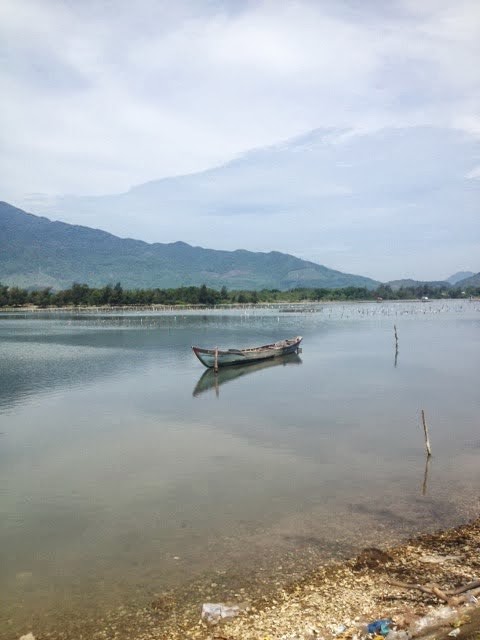
This geography didn't disappoint, as we drove past lush lagoons, fields of rice paddies, unspoiled mountain and coastal scenery and charming fishing villages.


It's an area that might be best explored with an ample calendar of time and via either bike or motorbike. 


But regardless if how one approaches this beautiful region,  Lord Norquist (aka Erik) and I felt especially grateful to be two of the humans on this planet to have been given the opportunity to see this region of natural and unparalleled beauty.  

It was a great drive!

The Imperial City of Hue, Vietnam

After the Royal Palace in Bangkok and Cambodia's Angkor Wat, I hadn't set a particularly high level of expectation for Vietnam's version of a royal city.    

What could possibly compete with what we'd already seen?

The answer?  

The Imperial capital of Vietnam's Nguyen Dynasty, which was created in 1802 and occupied until Vietnam's last Emperor abdicated and fled to Paris in 1945. 


I was fascinated and at times, overwhelmed, by the sights and stories we encountered on our tour of the enormous Vietnamese Emperor's outer estate, the Citadel (a component of which is pictured above), and his inner sanctuary, The Forbidden City; the remains of which are pictured below.  


Many portions of the imperial estate were damaged or destroyed French and later American invasions.  

But more recently, the Communist government in Hanoi has begun a serious and concerted effort to repair the extensive compound, including the rebuilding of entirely razed buildings like the library.  

Our blisteringly hot morning tour was replete with tales of mandarins (high ranking officers), eunuchs and concubines, and we found ourselves entirely transported to another time and a truly alien, to us, way of life..


Emperors, like the one captured in this extraordinary early photograph above, lived a God-like existence that sheltered them almost entirely from normal everyday affairs and even the glances of their peasant population.  

So segregated were they, in fact, that only eunuchs were permitted to live in the "inner sanctum" Forbidden City, along with the Emperor and his hundreds of concubines.  

The Emperor ruled over an incredibly vast compound of assorted buildings whose functions included housing of various levels of the elite, a library, a treasury, temples of various types and even theaters, like the superbly preserved one below.  


Interesting stories and anecdotes were shared by our knowledgeable and attractive tour guide. 

From her, for example, we learned that those boys selected to become eunuchs were ones who were already typically exhibiting feminine behavior.  

These boys would be identified by the leaders in the local, surrounding villages and castrated.  

The townspeople would then benefit via not having to pay taxes for a period of three years in exchange for this "gift", then presented to the Emperor.  

On second thought, maybe that abdication wasn't such an unfortunate occurrence after all....

Thursday, May 16, 2013

Hien and Our Lessons in Vietnamese Culture

Hien, our Vietnamese tour guide, was a pleasure to be with.  

As we passed by them, he'd shout out greetings to the local fishermen, most of whom he seemed to know personally.  


An incredibly robust forty two years old, He gave  up fishing five years ago for a more lucrative career as a tour guide.  

Interspersed among the hours spent exploring together, he shared insights into Vietnamese culture with us, telling us of his arranged marriage and how he expected the same for his son and daughter.  

He also told us of how the Vietnamese government had previously "encouraged" couples to have large families of about five children, but had now changed the official position to two, instead.   

(I suspect government officials in Hanoi are getting fed up with traffic there!)

He spoke of meeting his daily family expenses of $12 per day, and of his aspirations that his son, to whom he was teaching English, would also be a tour guide one day and experience and enjoy a further improved local ecological environment.  

He told us of some of the unique difficulties in growing up in this area of Vietnam. 

For example, the kids who grow up on oyster farms in the bay have traditionally had a high incidence of drowning, due to the fact that as soon as they start to crawl and walk, they risk accidentally falling into and drowning in the  multitude of fish and oyster pens that are their version of a backyard. 

In response, parents have traditionally placed their kids on 1.5 meter leashes, attached to one ankle, from about the age of two to four years old.  

This is intended to  prevent the possibility of accidental drowning, but, as a solution, comes at an obvious high cost to both parent and child.


But then, with great pleasure and relief, Hien told us of how, just recently, a Vietnamese mobile phone company began providing free and highly effective backpack-based "floaties" to these children.  

The result, he informed us, was that the number of sccidental drownings had now, mercifully, dropped precipitously.    


Hien also assisted us in our efforts to communicate with our other crew members, Sachs and Trang. 

They'd both been a bit standoffish at first,  but our attempts to communicate with them clearly broke the ice.  

They laughed at our "good mornings" when we meant "thank you" and Trang, in particular, took an active interest in extending our vocabulary. 


These hours spent between the scheduled touring events were, indeed, some of our most rewarding and valued of the tour. 

We departed our visit to our Vietnamese Shangri La with images fresh in our minds of tireless Hien walking in flip flops up a steep hiking trail,  our fellow crew members laughing, in a good natured way,  at our early attempts to speak Vietnamese and of Hien's promise to quit smoking before our next visit


Touring Kat Ba Island Archipelago


A  bus, a second bus, a ferry, a third bus and a motorcycle took us to our final destination; a small fishing village-cum-budding Mediterranean resort town, where Erik, Hien our guide, "The Skipper and Gilligan" (Sachs and Trung) and I boarded our boat.  

One of the unique aspects of our particular tour is that we were visiting an area that remains largely untouched by tourism aboard a traditional harbor junk, complete with sailing rig.

 We so clearly appeared "non touristy" that many of the locals seemed to do a double take when spotting Erik and me on board.  

On the day of our arrival, we started off with a vigorous one hour kayak, against the wind, to "Monkey Island."


Once there, we enjoyed an hour of swimming, snorkeling and frolicking with the (not all too friendly!) monkeys before making the long journey home as darkness fell.  

The second day on the boat was spent swimming and kayaking to caves that were part of recently-designated Kat Ba National Park.


On the third day, we bicycled in the morning and then Erik and Hien completed a vigorous hike up a local mountain and capture awesome photos of the archipelago we were sailing within. 


During our tour, we also enjoyed simply lying back and enjoying our tour of the harbor, which  is resplendent with karst formations; the picturesque and famous limestone peaks arising out of the water in this area of Vietnam.  

The effect of storms, sea and tides on these soft limestone conical structures present an endless kid's paradise of caves and pirate's coves to explore.   So we did!

Daily food for our luxurious lunches featured whole fish tuna and grouper, as well as stir fried chicken.  

Fresh produce was provided by the friendly Market Lady, who simply pulled her rowboat alongside our vessel to make her daily trades.